Playing the "Top 10 Movies Game" with my cineasta pals Marc Sober and James McGlothlin (and our Facebook Family) got me thinking about a new game: Top 10 Movie Books. But who am I kidding? I can't limit it to just 10...or 20, 30, 40...how about 50? These are the books that Marie Konda will have to use a crowbar to pry from my cold, dead fingers. I only pray that my wife will find a good home for them when I perish and fight the urge to dump them at the local Goodwill for a tax write-off. So, without further ado, I give you my "Essential Film Guides I Can't Live Without (And Which I'll Probably End Up Rereading If This Quarantine Continues)":

1. INCREDIBLY STRANGE FILMS (RE/SEARCH #10) by V. Vale
RE/Search #10 certainly lives up to its title. Profiles of Herschell Gordon Lewis, Russ Meyer, Larry Cohen, Ray Dennis Steckler, Ted V. Mikels, Doris Wishman, as well as "Industrial Jeopardy Films." Cover from Julian Roffman's 3D classic THE MASK (1961).

2. FILM AS A SUBVERSIVE ART by Amos Vogel
Before many of us even knew these films existed, the images contained within made us seek them out like a quest for cinenatic Holy Grails. If a picture ever spoke a thousand words...and sometimes the stills gathered here were the only proof of an obscure film's existence. Cover from Dusan Makvejev's W.R.: MYSTERIES OF THE ORGANISM.

3. CULT MOVIES by Danny Peary
Danny Perry, curator pat excellence, with Volume 1. A charismatic cult leader of the only cult I'd consider joining.

4. CULT MOVIE 2 by Danny Peary
But wait...there's more! 50 more! The sequel we all asked for, Vol. 2 introduced me to MORGAN, NIGHTMARE ALLEY, A BOY AND HIS DOG, THE WICKER MAN and ZARDOV. Not to mention cult cutie Claudia Jennings in THE GREAT TEXAS DYNAMITE CHASE.

5. CULT MOVIES 3 by Danny Peary
A Three-peat treat, Vol. 3 featured BLADE RUNNER, DIVA, GLEN OR GLENDA?, THE NAKED LISS, NIGHT OF THE HUNTER, FASTER PUSSYCAT KILL KILL, DR STRANGELOVE, IN A LONELY PLACE, THE ROAD WARRIOR and WALKABOUT.

6. GUIDE FOR THE FILM FANATIC by Danny Peary
Even more capsulized cult movie reviews that couldn't fit in the first 3 CULT MOVIE volumes. See also: Danny Peary's List of "Must See" Films from GUIDE FOR THE FILM FANATIC (1986) and 2,600 Additional "Must See" Films from Danny Peary's GUIDE FOR THE FILM FANATIC.

7. FILM NOIR: AN ENCYCLOPEDIC REFERENCE TO THE AMERICAN STYLE edited by Alain Silver and Elizabeth Ward
Alain Silver is my go-to sensei for all things Noir. Released in 1979, this was the first comprehensive survey of film noir published in English. Arranged alphabetically like an encyclopedia, this was also the first book to list a personal fave, John Berry's TENSION (1949). Respect!

8. THE SAMURAI FILM edited by Alain Silver and Elizabeth Ward
Need I mention that Alain Silver is also my go-to sensei for all things Samurai, as well? Silver's razor-sharp "first cut" swipe at the genre IS the deepest.

9. HOLLYWOOD BABYLON by Kenneth Anger
Kenneth looks back in Anger, and fondly too, at all the dishy dirt beneath the Hollywood Dream. A hardback tabloid.

10. SELECTED SHORT SUBJECTS by Leonard Maltin
No one knows Shorts like Maltin. It's all here, from OUR GANG and THE THREE STOOGES to Robert Benchley (pictured on the cover), W.C. Fields, Charley Chase, Joe McDoakes' SO YOU WANT TO...and BEHIND THE EIGHTBALL shorts, Pete Smith's MGM Specialties...you name it, Maltin's seen it!

11. MIDNIGHT MOVIES by Stuart Samuels
Before Netflix, before video stores, before cable, there was only one way to see the weird shit: staying up late! The original Sublime 9: ROCKY HORROR PICTURE SHOW, THE HARDER THEY COME (the only one I never saw), REEFER MADNESS, HAROLD AND MAUDE, ERASERHEAD, PINK PLAMINGOS, KING OF HEARTS, EL TOPO, NIGHT OF THE LIVING DEAD.

12. REVOLUTION! THE EXPLOSION OF WORLD CINEMA IN THE SIXTIES by Peter Cowie
Cowie covers the children of the revolution: Godard, Truffaut, Pasolini, Bertoluci, Oshima, Tocha, Polanski and Cassavettes. All leading up to the Cannes Film Festival riots of 1968 . Viva la revolution!

Sitney, quite simply: master of the experimental film. This is the essential book to read on the American Avant-Garde: Stan Brakhage, Kenneth Anger, Jordan Belson, Harry Smith, James Whitney, Maya Deren...and all the usual unusual suspects.

14. THE AVANT-GARDE FILM: A READER OF THEORY AND CRITICISM edited y P. Adam Sitney
Another essential P. Adam's Sitney collection.

15. SEX AND ZEN & A BULLET IN THE HEAD by Stefan Hammond and Mike Wilkins
My favorite guide to Hong Kong Cinema's 1990s' Renaissance and the global emergence of John Woo, Ringo Lam, Tsui Hark and others.

16. HOLLYWOOD EAST by Stefan Hammond
More Hong Kong Phooey from SEX AND ZEN & A BULLET TO THE HEAD author Stefan Hammond.

17. MONSTERS ARE ATTACKING TOKYO! by Stuart Galbraith IV
Renowned Godzilla scholar Galbraith's guide is essential reading for all fans of Japanese fantasy, kaiju eiga and terroryaki!

18. DVD DELIRIUM edited by Nathaniel Thompson
DVD DELIRIUM is an encyclopedic guide to 1,000 obscure films that have fallen between the cracks of recognition...until the DVD Era led to their excavation and rediscovery. Heavy on cult, horror, exploitation, sleaze and arthouse.

19. THE PARADE's GONE BY by Kevin Brownlow
Silent Is Golden: Kevin Brownlow is THE bible of the silent era. He was able to interview many of the pioneers while they were still alive. A celebration of what Brownlow considers cinema's peak period, superior to all that came thereafter.

20. IMMORAL TALES by Cathal Tohill and Pete Tombs
Tohill & Tombs's terrific tome (say that three times quickly!) covers the sexy horror films and filmmakers others consign disparagingly to "Eurotrash": Jean Rollins, Jess Franco, Walerian Borowczk, etc. This was the first book to treat them with FILM COMMENT-style reverance.

21. MONDO MACABRO by Pete Tombs
Tombs's followup to IMMORAL TALES is even better, as he shifts his focus from Europe to Bollywood; Hong Kong Kung-fu; Chinese Ghost and Hopping Vampire stories; Mexican masked wrestlers (El Santo!) and monsters; Turkish ripoffs of Dracula, Superman and Star Wars; Filipino spy-spoof FOR YOUR HEIGHT ONLY (starring midget Weng Weng as Agent Double 03 1/2); Japanese Pink Films and J-Horror. What's not to love.

22. A HUNDRED YEARS OF JAPANESE FILM by Donald Richie
You can't love Japanese Cinema without reading what Donald Richie has to say. A critical master who lives, breathes and eats all things Nipponese. The cover features "Beat" Takeshi Kitano as The Blind Swordsman Zatoichi.

23. THE YAKUZA MOVIE BOOK by Mark Schilling
Mark Schilling writes film reviews for JAPAN TIMES and his YAKUZA MOVIES collects the best writing on Japanese gangster films and filmmaker auteurs like Kinji Fukasaku, Takashi Miike, and Takeshi Kitano. The cover features the Japanese Robert Mitchum, Bunta Sugawara, in a scene from Kinji Fukasaku's BATTLES WITHOUT HONOR AND HUMANITY (1973).

24. OUTLAW MASTERS OF JAPANESE FILM by Chris D.
Chris D's OUTLAW MASTERS covers genre films - samurai, yakuza, pink, horror - and filmmakers like Seijan Suzuki (BRANDED TO KILL), Kinji Fukasuka, Kiyoshi "The Other" Kurosawa (CURE), Yaseharu Hasebe (BLACK TIGHT KILLERS)and Masahiro Shinoda. Plus great profiles of superstars Meiko Kaji (LADY SNOWBLOOD, STRAY CAT ROCK, FEMALE CONVICT SCORPION) and Sonny Chiba.

25. THE PSYCHOTRONIC VIDEO GUIDE by Michael J. Weldon
This is an update, as well as a sequel, of Michael J. Weldon's THE PSYCHOTRONIC ENCYCLOPEDIA OF FILM (1981), itself an anthology of his reviews from PSYCHOTRONIC VIDEO mag (I still have all my issues of this pop cultural treasure trove!). Booklist described Weldon as "the leading authority on films deemed to be "psychotronic," a designation he stretches to encompass horror flicks, spaghetti westerns, low-budget quickies, exploitation films of all stripes - in short, anything disdained by the critical establishment." In other words, my kinda movies!

26. NO BORDERS NO LIMITS: NIKKATSU ACTION FILMS by Mark Schilling
This is Schilling's examination of the stylish crime exploitation movies from Nikkatsu, the B-movie AIP of Japan's studio system, whose most famous director was Seijan Suzuki (Branded To Kill, Tokyo Drifter). Nikkastu's modern yakuza stories were considered "borderless" because they borrowed heavily from international influences, like Hollywood gangster films and the French New Wave (i.e., Godard's Breathless). We get profiles of the "Diamond Guys" (Yujiro Ishihara, Keiichiro Akagi, Tetsuya Watari and guitar-toting singer Akira Kobayashi of the Wataridori "Rambler" films) and the Westernized Joe Shishido (he of the artificially enhanced cheekbones, pictured on cover), female stars (Mie Kitahara, Ruriko Asaoka, Izumi Ashikawa, and the mesmerizing cult heroine Meiko Kaji); and studio auteurs like Seijun Suzuki, Yasuhara Hasebe (Black Tight Killers), Toshio Masuda (Velvet Hustler, Rusty Knife) and Koreyoshi Kurahara (I Am Waiting, Black Sun).

27. HOLLYWOOD LESBIANS by Boze Hadleigh
All the usual suspects (confirmed or otherwise). I like this interviews collection because it's got one of the few chapters devoted to personal favorite, the icy-cool French star Capucine (THE PINK PANTHER, WALK ON THE WILD SIDE), FELLINI'S SATYRICON).

28. EASY RIDERS, RAGING BULLS by Peter Biskind
Subtitled How the Sex-Drugs-and-Rock 'N Roll Generation Saved Hollywood, Biskind's book is a Who's Who of the movers and shakers who made their mark in 1970s Hollywood, a period of American film known for the production of such films such as The Godfather, The Godfather Part II, Chinatown, Taxi Driver, Jaws, Star Wars, The Exorcist, and The Last Picture Show. Most of the young Hollywood film directors (aka "movie brats") profiled have disavowed Biskind's interviews with them, with Spielberg remarking, "Every single word in that book about me is either erroneous or a lie." Fascinating reading, though, with all the usual (disavowing) suspects on hand: Altman, Ashby, Coppola, DePalma, Evans, Friedkin, Lucas, Rafaelson, Schrader, Scorsese, Town.

29. SPIKE, MIKE, SLACKERS & DYKES: A GUIDED TOUR ACROSS A DECADE OF AMERICAN INDEPENDENT CINEMA by John Pierson
The title refers, of course, to Spike Lee (of whom's She's Gotta Have It indie distributor Pierson was a staunch supporter), Michael Moore (Pierson was his rep for Roger & Me), Richard Linklater (Slacker) and various female directors/films (Susan Siedelman of Smithereens and Desperately Seeking Susan, Lizzie Borden of Working Girls, Donna Dietch of Desert Hearts), with the decade being the 1980s - the decade that saw the rise of video as a conduit for distributing otherwise neglected films by rising auteurs whose ranks included not on Spike, Mike, et al, but also Kevin Smith (of Clerks fame, who provides intermittent commentary via humorous Q & As with Pierson throughout the book), Pierson favorite Jim Jarmusch (Stranger Than Paradise, Down By Law), Steven Soderbergh (Sex, Lies and Videotape), Hal Hartley (Trust, The Unbelievable Truth) and countless others.

30. HARD-BOILED HOLLYWOOD: THE TRUE CRIME BEHIND THE CLASSIC NOIR FILMS by Max Decharne
Berlin-based British writer Max Décharné chronicles 11 gangster films, not all of which would be considered "classic" noirs, such as LITTLE CAESAR and GET CARTER. But no matter, he looks to the books that inspired these films as much as the celluloid end-product, with a passion and detail that impresses, especially his chapters on Robert Aldrich's KISS ME DEADLY (based on the Mickey Spillane novel), John Boorman's POINT BLANK (wherein I discovered the great "Parker" crime novels of Richard Stark, alias of Donald Westlake; this film was based on the first Parker book, 1962's THE HUNTER), Mike Hodges' GET CARTER (based on Ted Lewis's JACK'S RETURN HOME) and Nicholas Ray's IN A LONELY PLACE (based on Dorothy B. Hughes's titular novel - I discovered Hughes after reading this chapter and discovered that the book, told from the point of view of the killer, is even better than the movie, is even better than the movie, which offered a watered-down version of protagonist Dix Steele because having Humphrey Bogart portray a psycho killer was too dark for Hollywood). Of negative reviews of IN A LONELY PLACE, Decharne quotes one of my favorite lines: “If the director had taken the trouble to be French, we would be licking his boots in ecstasy.” Love that! Of course, it can't top Bogart's classic quote from the film: "I was born when she kissed me. I died when she left me. I lived a few weeks while she loved me." One for the Film Noir ages.

31. THE DEVIL THUMBS A RIDE & OTHER UNFORGETTABLE FILMS by Barry Gifford
Barry Gifford takes his title from a 1947 film noir starring Lawrence Tierney as sociopath Steve Morgan (of whom Gifford says, "evil doesn't lurk in his face, it gloats"). The author of countless books, his 1989 novel "Wild at Heart," was made into a David Lynch film the following year. In 1997 Gifford co-wrote the screenplay for Lynch’s, LOST HIGHWAY. Gifford's short, punchy two-page capsule reviews give an idea of what Charles Bukowski would be like as a film reviewer. An expanded edition of 1998's THE DEVIL THUMBS A RIDE, called OUT OF THE PAST: ADVENTURES IN FILM NOIR, came out in 2001. Ted Hicks has a great profile of Gifford at his Films, Inc. blog.

32. MENTAL HYGIENE: BETTER LIVING THROUGH CLASSROOM FILMS 1945-1970 by Ken Smith
In their day, the educational films shown in school were considered the future of liberal education, providing educators an opportunity to indoctrinate captive audiences in the proper ways of mental hygiene and physical safety. From the classic era of the ‘50s and ‘60s right up until ABC’s star-studded after-school TV specials in the ‘70s and ‘80s (which featured future celebs like Jodie Foster and Scott Baio), these cautionary tales covered everything from dating do’s and don’ts to the perils of drug abuse and wreckless driving in a hard-hitting style full of tragedy and devoid of subtlety. They were scary, yes, but also titillating – after all, where else could kids get the cheap thrill of seeing the kind of gratuitous drug use, sexual situations, death, destruction, and mayhem typically reserved for mature audiences in restricted motion pictures and late-night TV?
According to genre expert Ken Smith, author of Mental Hygiene: Classroom Films 1945-1970, these films constituted "a uniquely American experiment in social engineering" whose message was to “fit in” and follow “correct behavior” in grooming, manners, and citizenship. Smith synopsizes well more than a hundred leading examples, including Soapy the Germ Killer, a film tailor-made made for our COVID-19-challenged times.

33. HONG KONG ACTION CINEMA by Bey Logan
Bey Logan was one of the first to cover the exciting Hong Kong Action Cinema phenomenon when it was happening in the mid-'90s (now every Johnny To-Come-Lately has a book out about the genre), and this lavishly illustrated guide covers all the essentials, from Peking Opera to Chang Cheh (the master auteur!) and the Shaw Brothers, from Tsui Hark's fantasy warrior epics to John Woo's "Heroic Bloodshed" bullet ballets. Profiles of male stars Bruce Lee, Danny Lee, Chow Yun-Fat, Jackie Chan, Sammo Hung, Jet Li, Donnie Yen, Aron Kwok, Andy Lau, Yuen Biao, Simon Yam. Salutes to female stars Angela Mao Ying, Chang Pei Pei, Michelle Yeoh, Bridgette Lin, Chingmy Yau, Anita Mui, Sibelle Hu and Maggie Cheung. And a chapter on the oft-neglected "Chinese Ghost Story" films, including all those wild "Hopping Vampire" movies starring Mr Vampire himself, Lam Cing Ying. Cover depicts Chow Yun-Fat in Ringo Lam's Full Contact.

34. FILM NOIR READER edited by Alain Silver and James Ursini
There are several sequels to this ongoing series, but none better than the first, which compiles key early writings on film noir with newer essays. The best part is the "Case Studies" section, which profiles some of my favorite films and filmmakers, especially Mia's dad and "unsung auteur" John Farrow (THE BIG CLOCK, HIS KIND OF WOMAN, WHERE DANGER LIVES, NIGHT HAS A THOUSAND EYES); Robert Siodmak's THE KILLERS and his Cornell Woolrich adaptation PHANTOM LADY; Jules Dassin's NIGHT AND THE CITY ("I can think of no other title that better satisfies the formal criteria of the noir movement and...that delineates the noir universe so immediately for the uninitiated viewer," writes DVD TALK editor Glen Erickson), Otto Preminger's ANGEL FACE, Robert Altman's THE LONG GOODBYE, the films of Anthony Mann, and Alain Silver's own essay on "KISS ME DEADLY: Evidence of a Style."

35. THE GREAT MOVIES by Roger Ebert
Over 300 films cited as "landmarks of the first century of cinema" by the late great "Everyman" film critic, Roger Ebert.

36. 100 GREAT FILM PERFORMANCES YOU SHOULD PROBABLY REMEMBER - BUT PROBABLY DON'T by John DiLeo
DiLeo covers everything from Lillian Gish in Way Down East (1920) to Renee Zellweger in Nurse Betty (2000). Standout shout-outs include praise for Charles Laughton in Ruggles of Red Gap (1935), Lon Chaney in He Who Gets Slapped (1924), Tyrone Power in Nightmare Alley (1947), Robert Mitchum in Night of the Hunter (1955), Barbara Stanwyck in Remember the Night (1940), Claudette Colbert in Midnight (1939), Marilyn Monroe in Bus Stop (1956) and Richard Burton in The Spy Who Came In Out of the Cold (1965).

37. TOMS, COONS, MULATTOES, MAMMIES & BUCKS by Donald Bogan
The classic study of black images in American motion pictures, from The Birth of the Nation to Malcolm X. What it lacks in dynamic prose style it more than makes up for with its extensive documenting of African-American film history.

38. LEONARD MALTIN'S 151 BEST MOVIES YOU'VE NEVER SEEN by Leonard Maltin
Props to Maltin for resurrecting lesser-known worthies such as Man Push Cart, Matewan, The Tao of Steve, Idiocracy, Hedwig and the Angry Inch, Duck Season, Bubba Ho-Tep, The Harmonists, Rian Johnson's Brick and Roy Del Ruth's 1931 version of The Maltese Falcon starring Ricardo Cortez in place of Bogey.

39. VIDEOHOUND'S CULT FLICKS & TRASH PICKS edited by Carol Schwartz and Jim Olenski
As an Amazon reviewer put it: "This is a book that any cult movie lover should own. If the names Roger Corman, Lloyd Kaufman, Ray Dennis Steckler, David Lynch, Frank Henenlotter, Jack Hill, Herschel Gordon Lewis, Dario Argento, Paul Bartel, Russ Meyer, Terry Gilliam, Alex Cox, Edward D. Wood, Ken Russell, George Romero and John Waters mean anything to you then you need this book." Reviews of hundreds films, bios, pictures, pull quotes from featured movies and category indices (a Videohound specialty!) to help you find exactly what you're looking for.

40. VIDEOHOUND'S DRAGON: ASIAN ACTION & CULT FLICKS by Brian Thomas
This is the Bible of Asian Cinema. From blockbuster's like Crouching Tiger, Hidden Dragon, to cult faves like Mothra, and classics such as the Seven Samurai, readers will be treated to insights and highlights of the movies, casts, directors, and influences.

41. CARTOONS: ONE HUNDRED YEARS OF CINEMA ANIMATION by Giannalberto Bendazzi
Where to begin? I'll leave it to Library Journal: "This chronological history analyzes animated film as an autonomous art form that has nevertheless been affected by the economics of live-action cinema as well as social and political forces (e.g., the dislocation of Continental Europe's animators by World War II). This comprehensive study describes concepts and practice, profiles innumerable animators, and concludes with a chapter on computer animation. Because of truly global coverage (from Mali to Mongolia), Cartoons introduces such important animators as Russia's Alexandre Alexeieff and Scotland-born Canadian master Norma McLaren while providing details on familiar names like Disney, Walter Lantz, and Tex Avery. Despite the subject's popularity, this should not be considered a coffee-table book but a scholarly reference whose notes and bibliography are valuable sources for further study."

42. OF MICE AND MAGIC: A HISTORY OF AMERICAN ANIMATED CARTOONS by Leonard Maltin
The definitive guide to the history of American animated cartoons, covering the first 100 years up through the 1980s, including the "Golden Era" of '30s and '40s Warners Bros. and Disney 'toons, of which Maltin is the de facto expert. T-t-t-t-that's all folks!

43. THE ANIMATED MOVIE BOOK by Jerry Beck
Going beyond the mainstream hits of Disney and Dreamworks, Beck reviews every animated movie ever released in the United States, covering more than 300 films over the course of nearly 80 years of film history.

44. THE ROUGH GUIDE TO ANIME by Simon Richmond
From Amazon: "The Rough Guide to Anime provides a comprehensive overview of the diverse and amazing world of animation from Japan. Combining a critical approach with all the essential background information – from history and short biographies of the key people in the industry to the different genres, themes and cultural references of anime – this is the ultimate guide to Japanese animation. The book introduces the creative talents behind the major anime movies, TV series and OVA (original video animation) – from the Oscar-winning Spirited Away to classic works like Howl's Moving Castle, Princess Mononoke, and the iconic shows Astro Boy, Kimba the White Lion, Speed Racer and Robotech. Written by anime expert Simon Richmond, features include the Top 50 must-sees, with details on the most influential directors and creative artists. There''s an exploration of the art form''s history, plus information on the anime conventions and manga-related attractions in Japan. Newcomers will love the glossary of all the anime slang and jargon, while devoted fans will relish the fresh exploration of themes, genres and obsessions in the colourful anime universe."

45. THE INCREDIBLY STRANGE FILM BOOK by Jonathan Ross
This is a spin-off of English presenter Jonathan Ross's Incredibly Strange Film Show, a 12-episode television series examining "Psychotronic" B-movies and the low-budget filmmakers - John Waters, T.V. Mikels, Russ Meyers, Ed Wood Jr., Ray Dennis Steckler and Herschell Gordon Lewis - who made them. With a title referencing his TV show (which took its name from the RE/Search book Incredibly Strange Films), The ISFB examines those aforementioned heroes as well as gimmick-King William Castle, agromegaly-afflicted "Creeper" villain Rondo Hatton, drive-in movie schlock and "J.D." films.

46. THE COMPLETE THREE STOOGES: THE OFFICIAL FILMOGRAPHY AND THREE STOOGES COMPANION by Jon Solomon
The Complete Three Stooges is the reference guide for die-hard Stooge fans (I proudly count myself in that demographic), with detailed synopses, production notes, and anecdotes on every single short and feature-length film ever made by Les Stooges Trois, presented in chronological order (from their Rube Goldberg written first, 1930's Soup To Nuts to 1970's vacation travelogue Kook's Tour with Joe DeRita), as well as a handy-dandy detailed index.

47. EXPANDED CINEMA by Gene Youngblood
This 1970 book was the first to consider video as an influential media art form. Youngblood describes special effects, computer art, video art, multi-media environments and holography that "expand" the concept of filmmaking. Filmmakers reviewed include Jordan Belson, Patrick O'Neill, Stan Brakhage, Carolee Schneemann, Michael Snow, John Whitney, Paul Morrissey, Aldo Tambellini, Scott Bartlett and Nam June Paik.
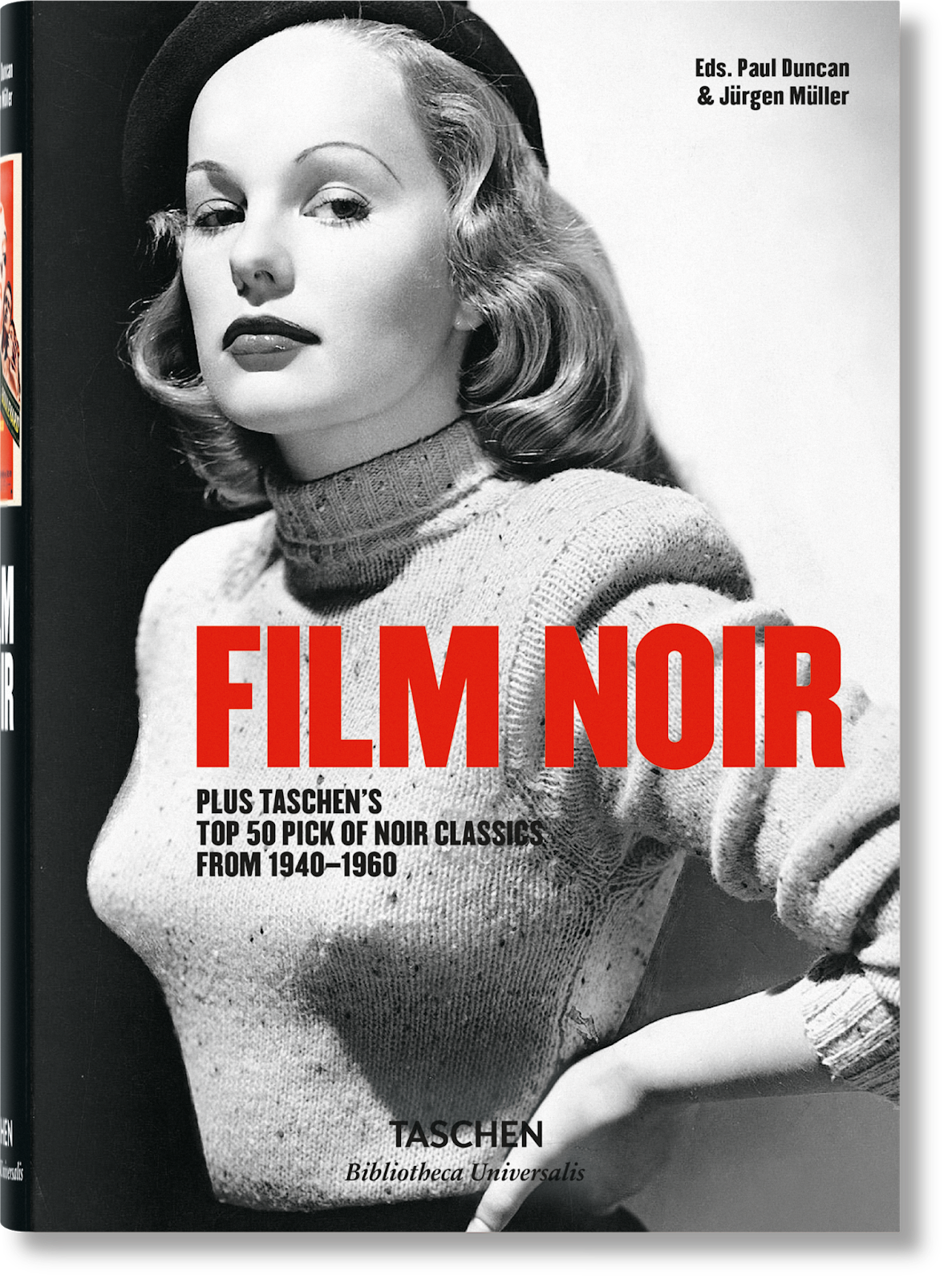
48. FILM NOIR edited by Paul Duncan and Jurgen Muller (a Taschen book with texts by Alain Silver, James Ursini, et al.)
A typically gorgeous, copiously illustrated example of the Taschen treatment of subject matter, in this case the dark and brooding world of Film Noir from 1940-1960, an essential guide brimming with the "private eyes and perfect crimes... corrupt cops and doomed lovers...enigmatic dames, desperate gangsters and psycho killers that continue to cast a long and captivating shadow over cinema." The editors have a personal Top 10 (Double Indemnity, Out of the Past, T-Men, Detour, Criss Cross, Gun Crazy, Touch of Evil, In a Lonely Place, The Reckless Moment and Kiss Me Deadly), as well as a chronological Top 50 - from Hitchcock's Rebecca (1940) to Truffaut's Shoot the Piano Player (1960) - that makes up the latter part of this chunky-with-goodness little tome. The first part of the book is broken into critical analysis chapters (What Is Noir, The Caper Film, The Private Eyes, Women in Film, Love on the Run, etc.) that explore the genre's various themes (The Haunted Past, the Fatalistic Nightmare), archetypes (The Truth Seeker, The Hunted, The Femme Fatale), signature visual iconography (Chiaroscura Lighting, Odd Angles, Moving Camera, Urban Landscape, Flashback and Subjective Camera) and diction (Hard-Bitten Poetry and Voice-over Narration).

49. DOCUMENTARY: A HISTORY OF THE NON-FICTION FILM by Erik Barnouw
One of the best historical overviews of documentary film, though somewhat dated. I had the 1983 edition, which has subsequently been brought more up to date to reflect the technological upheaval of digital film and smaller, more intimate-access camera techniques (looking at you here, Errol Morris). Still, I like Barnouw's approach of presenting thematic chapters devoted to Prophet (Louis Lumiere), Explorer (Robert Flaherty of Nanook of the North), Reporter (Kino-Pravda's "Man with a Movie Camera" Dziga Vertov), Advocate (modern documentarians like John Grierson, Axis of Evil advocate Leni Riefenstahl, Pare Lorentz of The River), Bugler (Frank Capra's Why We Fight war series), Prosecutor (post-WWII films like Alain Resnais' Night and Fog), Poet (post-war neo-realism from Rossellin's Open City, Arne Sucksdorff, Bert Haanstra), Chronicler (Colin Low and Walter Koenig's 1957 Oscar winner City of Gold, which told the story of the celluloid treasures buried beneath a Yukon Gold Rush town years before Bill Morrison's 2016 film Dawson City: Frozen Time), Promoter (corporate-sponsored films), Observer (Karel Reisz and Lindsey Anderson of Britain's so-called "Free Cinema" movement, Richard Leacock, Robert Drew of Primary, Albert and David Maysles, Fredrick Wiseman), Catalyst (Jean Rouche), Guerilla (Cold and Vietnam War-era stark "black films") and Discoverer.

50. 100 DOCUMENTARY FILMS by Barry Keith Grant & Jim Hillier
This is one of those great BFI Screen Guides, and it's hard to argue with any of the choices, from Jean Vigo's A Propos de Nice (1930) to Douglas Gordon and Philippe Parreno's Zidane: A 21st Century Portrait - the latter following the football superstar Zinedine Zidane through the course of a 2005 match between Real Madrid and Villareal, with a soundtrack by Mogwai. I haven't seen that film and, in fact, I haven't seen most of these docs, but I use this book as a handy little reference guide to what I need to see and check off my non-fiction bucket list. I especially liked the inclusion of Arthur Lipsette's Very Nice, Very Nice (1961), an extremely short 7-minute film composed almost entirely of still photographs gleaned from the files of his fellow National Film Board of Canada filmmakers. This is one of my favorite films that I discovered in the Enoch Pratt Library's 16mm film collection, and I was delighted to see it turn up as #94 in the alphabetic film chronology here. Lipsette, a former associate of Norman McLaren, depicts Western society as "alienated and determined by mass culture, advertising, consumerism, and militarism." His film-ending comment, "Bravo...very nice, very nice," is a cynical savaging of the shallowness of contemporary culture.


